# Introducing AIGI Network
### What is AIGI Network
**AIGI Network** is a blockchain-based infrastructure purpose-built for AI — designed to power the full lifecycle of AI systems: from data collection, model training, to attribution and reward distribution.
Our goal is simple but ambitious:\
**To build a verifiable, decentralized AI network where contributors — whether data providers, model builders, or validators — are fairly rewarded based on their actual impact.**
### How It Works
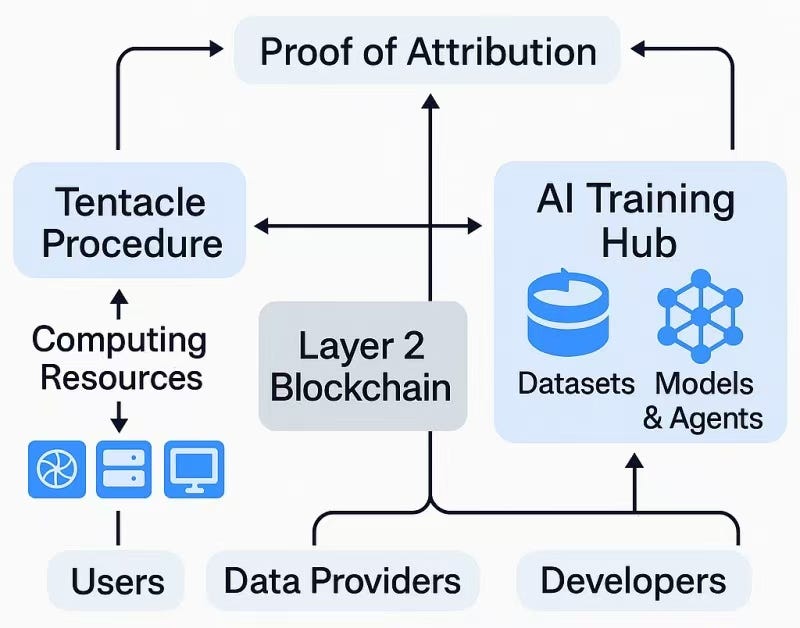
AIGI Network introduces several key components:
#### 🕸 Tentacle Procedure — The Edge Compute Layer
The **Tentacle Procedure**, our decentralized compute aggregation framework. It allows us to harness idle GPUs and edge computing devices globally, forming a distributed compute mesh to support AI workloads, especially for high-quality data collection pipelines.
#### 📊 AI Training Hub — The Model Engine
Data and compute flow into the **AI Training Hub**, where models and intelligent agents are trained on curated, high-quality datasets. The hub supports open participation, enabling developers and researchers to train models within a transparent, auditable environment. Data, models, and agents can be exchanged on demand within its marketplace.
#### 🧾 Proof of Attribution (PoA)— The Value Layer
This is where AIGI sets itself apart. Every AI output (e.g. an agent decision) is linked back to the data that made it possible. Contributors are rewarded based on verifiable attribution — not vague promises.
* Did your data significantly influence a model’s output? You get paid.
* Did your agent perform well in training? You build reputation.
* Did your AI validation prove effective? You get rewarded.
Everything is **tracked on-chain**, auditable, and composable.
#### 🔗 Layer 2 Blockchain— The Protocol Layer
The AIGI Network runs as a Layer 2 blockchain, optimized for:
* Fast execution of inference and training-related requests
* On-chain verification of off-chain computation
* Low-cost, high-throughput attribution tracking
It serves as the protocol layer for the **AI economy**, where intelligent agents, models, data, and compute resources interact — and value flows fairly.
At the protocol layer, we’ve built a full infrastructure for AI Agents, including:
\
• Agent authentication
\
• Native accounts
\
• MCP tools
\
• The X402 protocol
\
Agents will be able to autonomously call tools across blockchains, collaborate to complete tasks, and earn rewards.
### AIGI’s Core Belief: Attribution is Value
At the heart of AIGI Network lies a simple but powerful belief:
> ***“If your data, your compute, or your model helped produce an AI output — you deserve a share of the value it generates.”***
Unlike traditional AI pipelines where value accrues to a single owner, AIGI makes value distribution **programmable, transparent, and fair**.
This belief is embodied in the network’s foundational design:
* **Attribution = Ownership**
* **Ownership = On-chain Proof**
* **Proof = Payout**
Every participant is no longer a disposable backend — but a **stakeholder in the AI economy**.
---
# Agent Instructions: Querying This Documentation
If you need additional information that is not directly available in this page, you can query the documentation dynamically by asking a question.
Perform an HTTP GET request on the current page URL with the `ask` query parameter:
```
GET https://aigi-protocol.gitbook.io/aigi-protocol/overview/user-facing/aigi-network/introducing-aigi-network.md?ask=
```
The question should be specific, self-contained, and written in natural language.
The response will contain a direct answer to the question and relevant excerpts and sources from the documentation.
Use this mechanism when the answer is not explicitly present in the current page, you need clarification or additional context, or you want to retrieve related documentation sections.